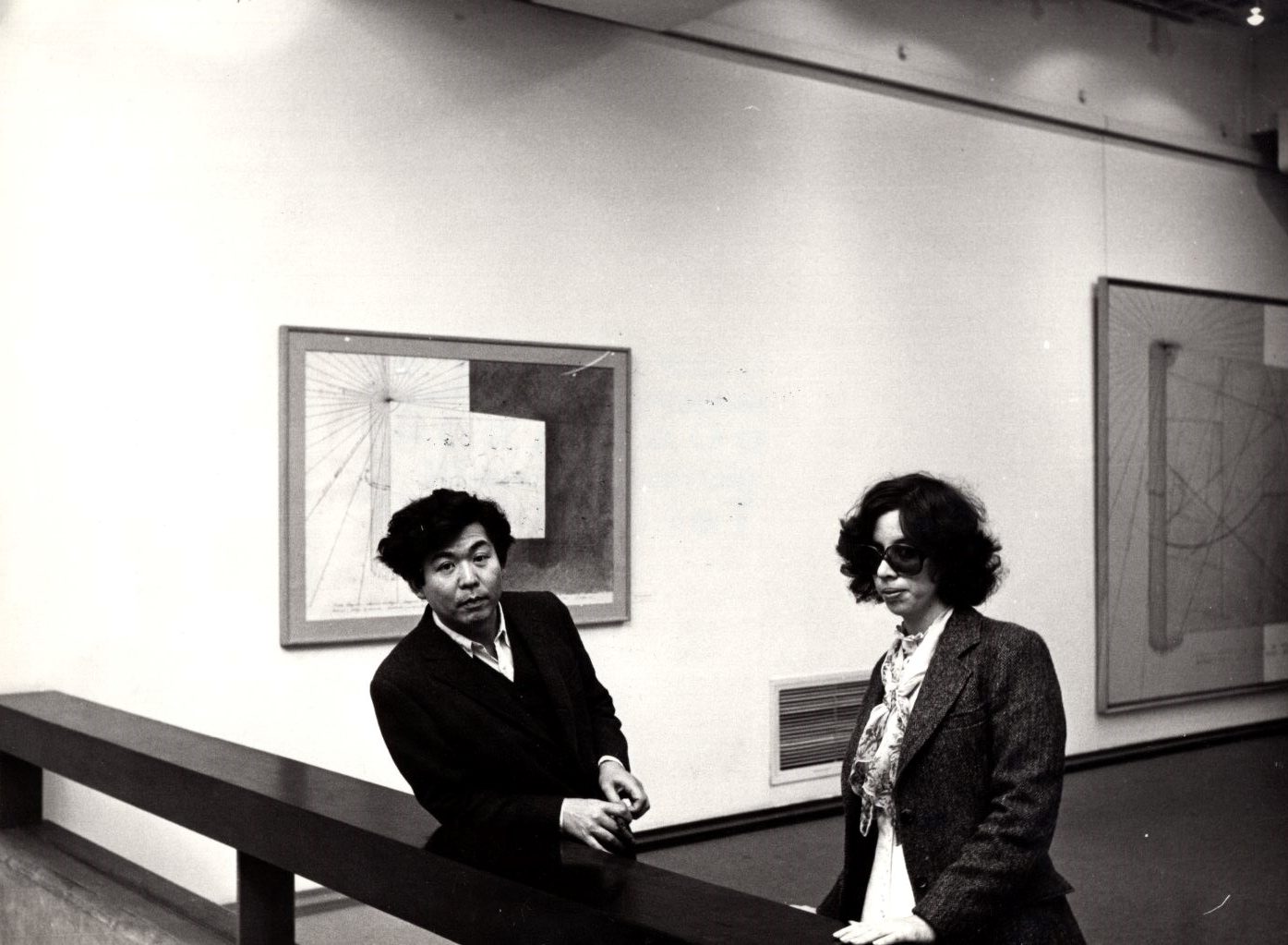
Arakawa+Gins were a duo of creative visionaries whose collaborative and experimental practice of architecture incorporated art, philosophy, and science to radically reimagine the conception of life and humanity. Their practice was grounded in their theory of “reversible destiny,” the belief that human mortality could be defied through alternative forms of architecture.
For nearly five decades beginning in 1963, Arakawa (Shūsaku Arakawa) and Madeline Gins worked together across art, architecture, film, and writing to destabilize inherited frameworks of knowledge and to reinvent modes of sensing and relating to the world. Their collaboration can be traced to The Mechanism of Meaning (1963–71, 1978, 1988, 1996), a multi-decade “research project” that they began shortly after they met in 1962 at the Brooklyn Museum Art School. Their partnership was solidified by their marriage in 1966. Comprising eighty-three large-scale panels (96 x 68 in.) that combine images, words, and objects, The Mechanism of Meaning presents a series of interactive exercises and thought experiments designed to create “a conceptual distance between the thinker and the thought.” Organized into nineteen “chapters,” these exercises unmoor the mind and senses from prescribed logics, urging their recalibration. Two editions of The Mechanism of Meaning exist. The first suite, begun in 1963, debuted in the Japan Pavilion at the 1970 Venice Biennale, and culminated in 1996 for Arakawa and Gins’s 1997 solo exhibition at the Guggenheim Museum SoHo. The second version was created in 1988 and is currently in the collection of Sezon Museum of Modern Art in Japan. Considered a work-in-progress over the course of three decades, The Mechanism of Meaning is documented in four separate publications in English, Japanese, and German.
In 1969, Arakawa and Gins produced their first experimental feature-length film, Why Not: A Serenade of Eschatological Ecology, followed by For Example (1971), both of which premiered at the Whitney Museum of American Art. Why Not centers on a young woman in an erotically charged domestic space, while For Example features a drunken homeless boy wandering the decaying streets of the Bowery. Provocative and subversive, these films foreground the protagonists’ unconventional bodily engagement with their environments, undoing normative protocols of behavior and spatial order.
Beginning around 1980, Arakawa and Gins increasingly collaborated to rethink the relationship between the built environment and the body; in the early 2000s, they adopted the joint studio name Arakawa+Gins. Their indoor installations from the 1980s and early 1990s, such as The Process in Question/Bridge of Reversible Destiny (1973–1989) and Ubiquitous Site X (1987–1991), prefigure their full-fledged architectural projects of the 1990s and 2000s. Before Arakawa’s passing in 2010, they completed five architectural projects across Japan and New York: Ubiquitous Site, Nagi’s Ryoanji, Architectural Body (1994), Site of Reversible Destiny—Yoro Park (1995), External Genome House—Shidami (2005), Reversible Destiny Lofts—Mitaka (In Memory of Helen Keller) (2005), and Bioscleave House (Lifespan Extending Villa) (2008). In 2013, Gins completed the Biotopological Scale-Juggling Escalator at Dover Street Market, New York, based on one of Arakawa+Gins’s numerous unrealized designs for housing complexes, parks, cities, and hotels.
Characterized by vivid colors and dynamically shifting terrains and enclosures, their installations and architectural projects prompt audiences to see, touch, and move through space in unfamiliar ways. By warping space-time and realigning our bodily sensorium, the duo opened a path toward deflecting the predetermined course of life and learning “not to die.” These ideas inform their co-authored books Pour Ne Pas Mourir / To Not to Die (1987), Architectural Body (2002), and Making Dying Illegal (2006).
In 1987, Arakawa and Gins established the Containers of Mind Foundation, which was renamed the Architectural Body Research Foundation in 1998. In 2010, they launched the Reversible Destiny Foundation, which continues the duo’s work today. Beyond stewarding the legacies of these two extraordinary individuals, the Reversible Destiny Foundation carries forward their vision by cultivating an open space where boundary-defying ideas, collaborations, and friendships are welcomed and nourished as a living practice.