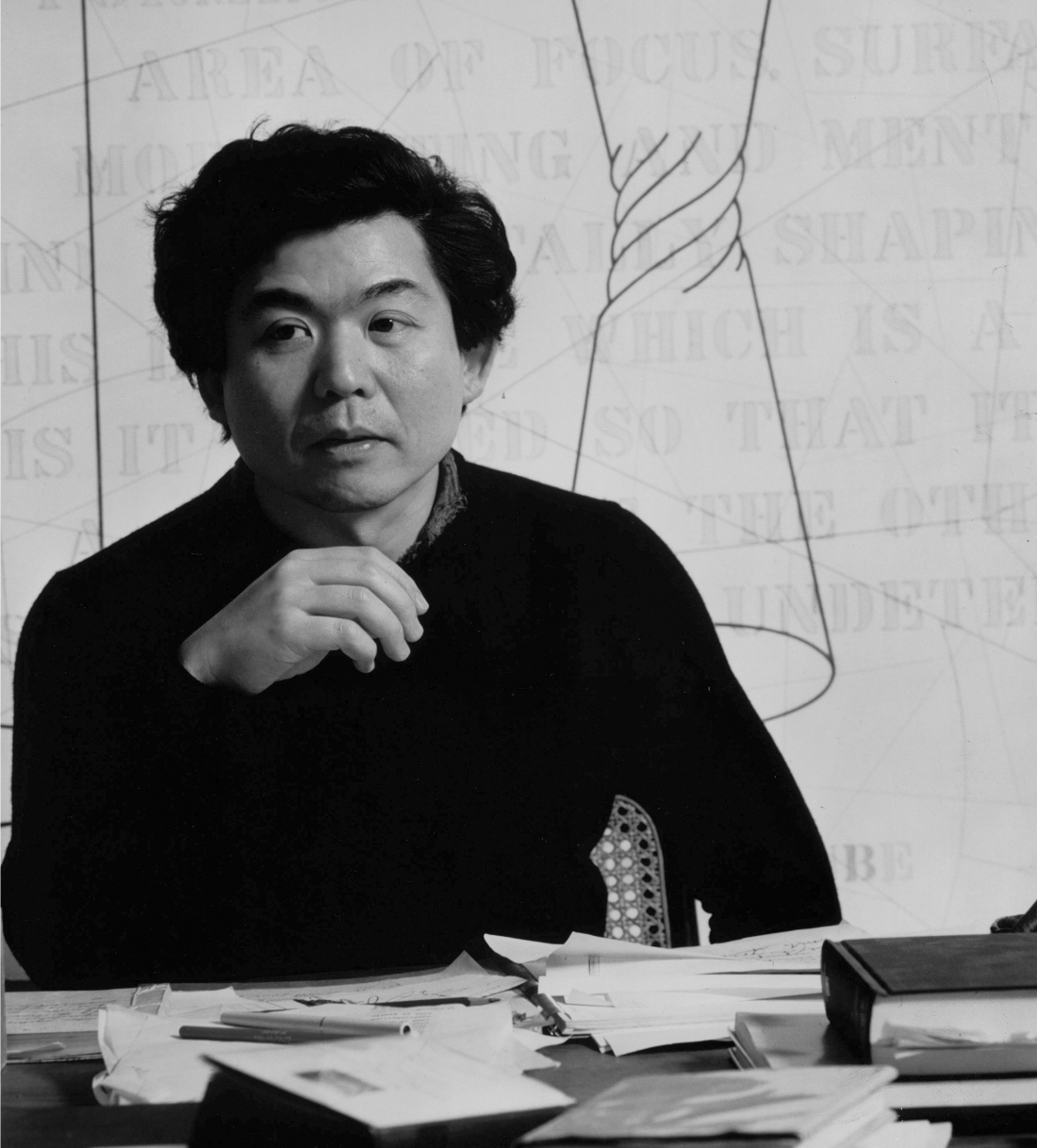
Arakawa (Shūsaku Arakawa) was an avant-garde artist and architect whose paintings, sculptures, installations, and architectural projects tirelessly probed the limits of perception, language, and the body’s relationship to the world. A self-proclaimed “abstractionist of the distant future” and “eternal outsider,” he developed a distinct conceptual language that combined diagrams, cryptic text, and scientific and philosophical allusions to unsettle and transform the normative bounds of art and thought. He was one half of the architectural duo Arakawa+Gins.
Arakawa briefly attended Musashino Art School (now Musashino Art University) in Tokyo in 1956. From 1957 to 1961, he exhibited at the annual Yomiuri Independent Exhibition. In 1960, he was a member of Neo Dada, a Japanese avant-garde collective that defied established art institutions amid the widespread political protests against the renewal of the U.S.–Japan Security Treaty (Anpo). Through his two solo exhibitions in 1960 and 1961, he gained critical attention for the so-called “coffin” sculpture series. Often bearing a title that contains scientific references, each “coffin” work consists of a cement mass evocative of a deformed body part, encased in a colorfully lined wooden box.
In December 1961, Arakawa emigrated to New York. With the support of Surrealist poet and critic Shūzō Takiguchi, he had sent several letters to Marcel Duchamp before arriving in New York. Adopting his family name, Arakawa, as his artist name, he quickly found himself fully immersed in New York’s avant-garde milieu. Through Duchamp and Yoko Ono, he met John Cage, Jasper Johns, Robert Rauschenberg, Robert Morris, Andy Warhol, and Fluxus artists such as Ray Johnson, Dick Higgins, and Alison Knowles. In 1962, he met Madeline Gins at the Brooklyn Museum Art School; the two would form a lifelong creative partnership. In late 1963, he began exhibiting regularly at Dwan Gallery (Los Angeles and New York); in the following year, he held his first European solo exhibition at Galerie Schmela in Düsseldorf.
In New York, Arakawa increasingly turned to two-dimensional work, developing what came to be known as “diagram paintings.” Although dots and arrows had appeared in his work since 1958, their development in New York took a distinctive turn. Works from 1962 to 1965 typically combined pared-down diagrams with “shadows” created by spraying over objects, generating traces of movement across the surface. He sometimes incorporated reproductions of chronophotography and readymade objects—such as an umbrella and a funnel—that signaled his Surrealist and Dadaist roots. Through the 1960s and 1970s, these paintings expanded to incorporate an eclectic range of motifs, such as blueprints, stenciled text, windows, eye exam charts, color spectrums, directional arrows, tubes, and radiating geometric forms.
Arakawa’s use of language was distinct from that of his contemporaries working in Conceptual Art in Europe and the United States. His text is deliberately enigmatic and semantically unstable, steeped in scientific and philosophical allusions. Paired with diagrams, it transforms the paintings into apparatuses for testing the limits of art, perception, and reality, resulting in “a strange, enticing game—a game of continually thinking out” (Hans-Georg Gadamer). This approach anticipated his deepening critique of painting as “fiction” and his broader inquiry into the conditions of perception and embodied existence. Crucial to this development was his collaboration with Gins, especially their long-term project The Mechanism of Meaning (1963–71, 1978, 1988, 1996) and their emerging theory of “not dying.” Concepts developed together with Gins, such as “Blank” and “to cleave,” also recur in his paintings.
With the duo’s growing immersion in architecture in the 1980s, Arakawa’s paintings also took on a more environmental character. From 1986 to 1991, he created installations of multi-panel paintings paired with floor panels. Sometimes equipped with rope, the floor component is either laid flat or unevenly sloped, creating a space for the audience to traverse and experience through active, full-body engagement rather than purely retinal perception. In 1991, he contributed eight photoengravings to illustrate a special edition of Edgar Allan Poe’s Eureka, An Essay on the Material and Spiritual Universe (1848).
Arakawa’s work has been exhibited extensively at major museums worldwide and in large-scale international exhibitions such as the Venice Biennale (1970) and documenta (1968, 1977). His work is held in the collections of The Museum of Modern Art, New York, The Metropolitan Museum of Art, Whitney Museum of American Art, Smithsonian American Art Museum, Walker Art Center, Philadelphia Art Museum, and Centre Pompidou, among others.

Awards
| 1986 | Awarded by the French Government: Chevalier des Arts et des Lettres |
| 1987-88 | John Simon Guggenheim Fellowship |
| 1988-89 | Belgian Critics’ Prize |
| 1997 | College Art Association’s Artist Award for Exhibition of the Year/Distinguished Body of Work, Presentation or Performance Award |
| 1998 | The highest award in the Rainbow Town Urban Design Competition goes to the Arakawa/Gins Chinju no Mori/Sensorium City (Tokyo Bay) |
| 2003 | Shiju Housho – Medal with Purple Ribbon Nihon Gendai Geijutsu Shinko Sho – Award for innovation in Japanese contemporary art from Japan Arts Foundation |
| 2010 | The Order of the Rising Sun, Gold Rays with Rosette |
Conferences
| 2005 | “Arakawa and Gins: Architecture and Philosophy,” University of Paris X-Nanterre |
| 2008 | “Reversible Destiny Declaration of the Right Not to Die: Second International Arakawa +Gins Architecture + Philosophy Conference/Congress,” University of Pennsylvania, Slought Foundation |
| 2010 | AG3: The Third International Arakawa and Gins: Architecture and Philosophy Conference, Griffith University, Australia |