Categories
Events

Shusaku Arakawa: Trans Japan, Cis Japan

Reversible Destiny Foundation is pleased to present Shusaku Arakawa: Trans Japan, Cis Japan – an article by Dr. Shin-Ichi Fukuoka about the works of Arakawa and Madeline Gins. Originally published in Japanese in WINGSPAN February 2016 issue, pp. 80-6. Translated and republished here with permission from the author and ANA WINGSPAN – the monthly in-flight magazine from All Nippon Airways.

Dr. Shin-Ichi Fukuoka (b. 1959, Tokyo) is a biologist, Professor at Aoyama Gakiuin University and Visiting Professor at Rockefeller University in New York City. He was the recipient of the Asahi Shimbun Science Promotion Prize (1987) and The Japan Bioscience, Biotechnology and Agrochemistry Society Award for the Encouragement of Young Scientists (1997). Dr. Fukuoka has published more than 80 original papers in prestigious scientific journals, including Nature. He is also a renowned writer of award-winning books bridging the gulf between the two cultures of science and the humanities.

Shusaku Arakawa: Trans Japan, Cis Japan By Shin-Ichi Fukuoka

Site of Reversible Destiny

I paid a visit to a giant artwork made by contemporary artist Shusaku Arakawa, along with Madeline Gins, in Yoro, Gifu Prefecture: Site of Reversible Destiny. I slowly ascended the slope. I had a strange premonition, and I put all the more strength into stepping firmly on the ground. It was a disquieting sign, as if my senses were somehow being disturbed. 

Presently I reached the slope’s crest. With the various peaks of the Yoro Mountains in the background, an astonishing view opened before one’s eyes. It looked like an ancient amphitheater, or the outer rim of the large mouth of a volcano, or a crater formed by the impact of an enormous meteorite. Or perhaps that futuristic spectacle of the flying saucer that appears in “Close Encounters of the Third Kind” quietly landing on the ground. At first I was entranced by that enormous sense of scale, but gradually as my eye became accustomed to the structure of the details, the notion that floated up within my heart was not volcano or crater or spacecraft, but an entirely different word: “This is precisely and exactly a cell.”

The curved line of the cellular wall runs around the circumference. In this line are embedded receptors and channels, in the form of apparatus that exchange information with the extracellular world, penetrating the cellular wall. Within the cell the maze-like endoplasmic reticulum, the nested mitochondria, the centrosome that appears like a bundle of branches, the golgi apparatus with its piled up round lamella, the nucleus that housed the fine strings of DNA, all those sorts of cell organelles are arranged in a scattered formation.

Strangely shaped structures are placed all around here, as if precisely corresponding to each organelle. Had Arakawa seen cells under a microscope before? Or is the thing expressed here perhaps the concept of everything in the real cosmos projected like a mirror reflection into the microcosm of a cell? This was the moment I first felt the ‘life’ at the center of Arakawa’s thought.

Shūsaku Arakawa was born in Nagoya in 1936. Looking to pursue art, he not only progressed through art school, but in his mid-twenties he went to the US and settled in New York. Here he meets the poet five years his junior who will become his life partner, Madeline Gins, and from that point they begin to work collaboratively.

What catapulted Arakawa+Madeline to fame was a conceptual art series called The Mechanism of Meaning. On a big picture plane, plus and dot symbols, or else diagrams that include color, are scattered all over. Under these, instructions are written: “Please think only of the dot not of the x’s.” In other words, forbidding the viewer from simply look at the artwork, participation or some sort of action becomes required here. In this prohibition, the process of human perception arises. The world was surprised by this mechanism. Werner Heisenberg, the winner of the Nobel Prize in Physics, showed considerable interest in Arakawa’s work, and it issaid that he had long chats with Arakawa. Not simply looking, but provoking participation and action. Arakawa’s intentionality was already emerging at this time. The scale of his intentionality was then enlarged and concretized as a more active force moving forward. The result was the magnificent monument completed in 1995: Site of Reversible Destiny. In the circular space of this basin a structure that seemed tobewitch the senses was arranged: a house standing slantwise, with dead-end hallways, maze-like rooms, and furniture embedded in walls. I tried challenging one amongst these features. There is one rectangular entryway bored into a sloping face. A narrow passageway continues inside. When I tried entering, I could see the dimly lit walls for a while from the slight bit of light that came through the entrance, but as I continued down the winding passageway, I was enclosed by a complete darkness. At that moment, a bottomless dread stealthily drew near. And at the same time, a voice in my heart told me to calm down. I closed my eyes and turned my attention to the sensation of the walls I could touch with my two hands. I perceived the direction that the hallway bent in and soon I could see a faint light at the other end of the passage, at which point I came to understand the passageway I had entered into. I realized the dark hole into which I entered was not really all that deep.

What is darkness? What happens in the darkness? If I were to describe the intention of Arakawa’s work in one phrase, I would say that losing our sight in the darkness was not a loss, rather it was an opportunity to open new doors in our brains. A rich technique that more than made up for the loss; our senses aside from vision rise up, and we try to view the world via a new method. In other words, the darkness becomes the impetus by which we sense, bodily, the flexibility and mutability of life. In that moment, life exceeded our own bodies and spreads outward. That sensation is something that continues, even after leaving from the darkness.

Arakawa came to speak increasingly peculiar words. His characteristic phrasing was declarative and at times aggressive. It confused most people, but on the other hand, it attracted not just a few people. Arakawa would say, “I am a new scientist. If one is trying to become an artist, one at least becomes a scientist,” and “European philosophy is made up purely of lies.” Arakawa’s way of speaking was, rather than speaking to someone, more like a constan monologue. It could also be heard as a sort of agitation, or like a curse: “Science has not accomplished one thing, in regards to life,” and “Science doesn’t know what is living and what might be dead!”

And then Arakawa proclaims, “Humans don’t die. I’m saying that they can’t die. I’ve discovered this. What we call humans can surely live forever.” It is true that he continued pondering the question of life. However, he did so using a completely different methodology than us biologists.

Site of Reversible Destiny, Yoro Park, Gifu, Japan
Reversible Destiny Lofts - Mitaka (In Memory of Helen Keller), Tokyo, Japan

“Immortality,” and the Reversible Destiny Lofts Mitaka

Ten years after the Site of Reversible Destiny, the Reversible Destiny Lofts Mitaka, in Mitaka City, Tokyo, were constructed as a place to realize “immortality.” Built along a major road, it’s a totally unexpected building that stuns those who visit. Cubic and circular columns are stacked on each other complexly. Their colors are red, blue and yellow. It’s as if a child lined up blocks capriciously.

Momoyo Homma, the Representative of the Arakawa Shūsaku+Madeline Gins Tokyo Office, guides me on a tour and I observe the interior. Of the nine units that make up Reversible Destiny Lofts Mitaka, some are used for rental housing and some for short-term apartments.

Presumably everyone who visits here feels this: a hesitation toward entering the interior. The floor undulates irregularly. Spherical rooms, circular tatami, bathrooms without doors, and switches purposely installed below one’s feet and above one’s head. You really can’t settle down at all. This is not a place for people to live. Anyone would feel this way. For instance, there are passages as follows in the instructions for the residence: “Please try entering this dwelling unit as if you were a 2- to 3-year-old child as well as a 100-year-old senior.”

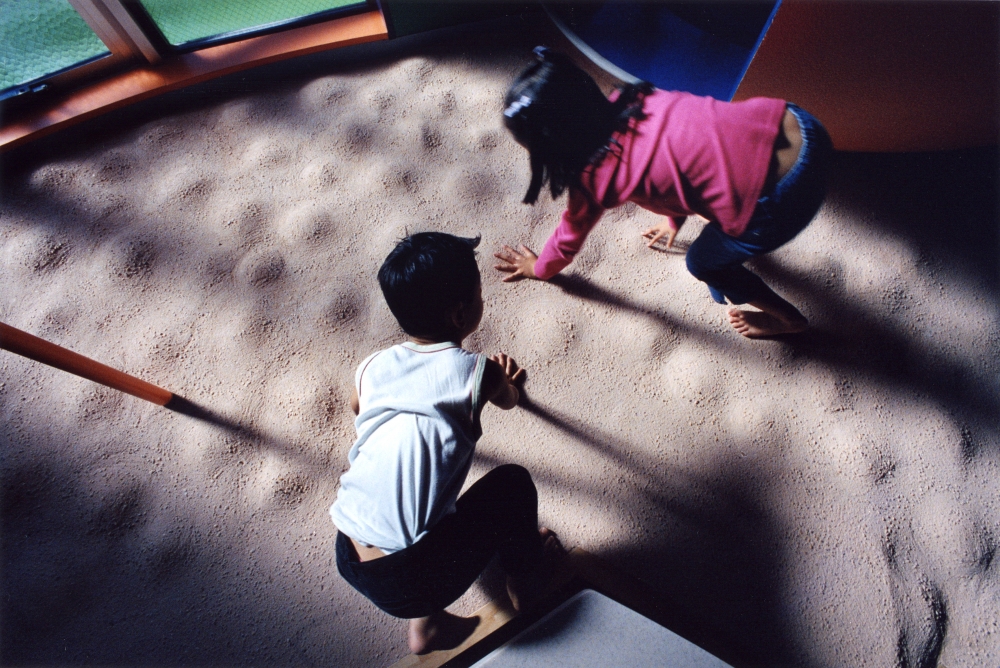
In reality, upon entering, you directly feel the unevenness of the floor on the underside of your foot, and it feels as if your body’s balance is being destroyed. In the spherical room, your voice reverberates, and you are caught in a strange sensation. Where the floor is sloped, your Achilles tendon is stretched, and in order to turn on the lights, you must search for the location of the switch and stoop over or twist your body. However, this is exactly what Arakawa intended. “Use all the things in this room and from now on you all will become real scientists. This is a place that draws out the possibilities of the body, inverting the destiny called death,” as Arakawa says. Modern society produced dwellings, divided up by horizontal and vertical planes, as something that cuts us off from the outside environment, isolates us, and protects us. In exchange for safety, humans end up losing sight of something important. We must turn our ears once more to the expandability of the body, or of life, that our five senses can teach us about.

We move around various places within our room, touch the floor and walls, survey the outside through our window, and pass the time for a bit in the small space created next to the central kitchen. I realized that mysteriously, the longer we are in this space, the interior atmosphere that was initially dominated only by its strangeness rapidly changes into something kind and tender. In the end, I even came to feel that I wanted to stay like this, in this place, even longer. Something about it came to be nicely familiar. Certainly our bodily sensations are liberated, or stimulated, in a different form here than in daily life. However, did Shūsaku Arakawa really, seriously think that people could continue to live without dying? Was that not, just like his way of speaking, his style of bluff?

“Trans Japan, Cis Japan.” In order to investigate the origin of this trans-Japanese ideology of Shūsaku Arakawa’s, which has acquired a universalism at the place where he has broken out of Japan to pass far beyond the domestic, I set off for New York.

East Hampton, Bioscleave House

The long, thin form of Long Island sticks out from New York City like a fork, toward the east. Bioscleave House, which Shūsaku Arakawa and Madeline Gins designed, is in East Hampton, one of the vacation spots on the island. Bios is the prefix that refers to life, and cleave has two contradictory meanings: one is to sever, and the other is to join.

From the road, every now and then I can see the blue sea appearing and disappearing. When I thought to myself that neat and trim buildings had appeared, it turned out to be East Hampton’s Main Street. As the car emerged from another grove of trees into a neighborhood of summer villas, from the openings between trees I could catch a glimpse of yellow and purple walls that seemed out-of-place amongst the homes in this kind of area. Everyday senses are severed and extraordinary tactile sensations are reconnected. Oh, Shūsaku Arakawa is Shūsaku Arakawa even here!

Bioscleave House is of an even larger scale, powered up in comparison to the Reversible Destiny Lofts Mitaka. It’s spacious. And its eccentricity is overdone. The undulating floor makes a large basin structure. In the center, a kitchen is surrounded by a curved line, rooms are skewed at an angle around the exterior, the wall is penetrated, and the ceiling is tilted at an angle. In an open bathroom, two toilets are lined up back to back. Who on earth would you say would use this in what way? But at the same time, I thought that Bioscleve House was a mirror projection of the Site of Reversible Destiny. Then, in here we have the image of a micro cell, and in the interior of the cell, the image of an infinite universe is contained like an embedded structure.

In the New York office of Arakawa+Gins, I listened to the stories of Joke Post, who was in extremely close contact with the two.

“Was Arakawa seriously thinking that people would not die?”

“That’s a difficult point. I interpret it as follows. By stimulating the five senses in a different way from the everyday, we release the consciousness and spirit that we imagine as internal to our own bodies into the outside world. This thing that is the outwardly expanded self can be omnipresent in every space and place. I think it must be that kind of thing, no?”

Bioscleave House (Lifespan Extending Villa), East Hampton, New York, USA
Biotopological Scale-Juggling Escalator, Dover Street Market, New York, USA

Shūsaku Arakawa and Life Science

On my return to Manhattan, through Ms. Post’s introduction, I stopped by the Houston Street building occupied by Shūsaku Arakawa and Madeline Gins’ studio and residence. The location is a busy street not far from the Soho area. One whole old building was their headquarters. I wonder what kind of state this area was in during the 1960s and 1970s?

I noticed the fact that innumerable publications have been left behind. Scanning the titles of the books and magazines artlessly packed on the bookshelves with my eye, I was gripped by a strangely strong feeling. Science, Philosophy, Biology, Anatomy, modern thought, New Wave, Theory of Life, Organicism, Holism…books I myself had once read with all my might were inconspicuously lined up there. The Shūsaku Arakawa who departed from Japan early on and concentrated on an independent art practice in the far off soil of America was, at the same time, also precisely tracing the tides of popular intellectual discourse that were being published contemporaneously in Japan.

In Arakawa’s early works, he often assigned titles that evoked images of life sciences: Waksman and Oparin. Waksman was the discoverer of antibiotics, and Oparin was the figure who thought of the origin of life as chemical evolution. It is certain that Arakawa maintained a close watch over developments in life sciences. Images of life and cells are clearly present in his artworks. Plus, he was well informed about the reductionist, mechanistic views of life at which modern life sciences had arrived. Life exists as a precise combination of micro components. Thus with the completion of the genome project, the secret of life thought to be infinite is also a clockwork orange consisting of countable genetic parts.

However, he never acknowledged the value of this way of thinking. He treated modern science as completely missing the comprehension of life. He demonstrated a vivid antithesis, as seen in Site of Reversible Destiny and Bioscleave House. Life is not found inside a single specimen. It exists as something outwardly expansive. Life that has been expanded once has no

end. In other words, it does not die.

It suddenly occurred to me that I wonder if Arakawa knew about the biochemist Rudolph Schoenheimer who conducted research in New York in the first half of the Twentieth Century. Schoenheimer was a scientist who demonstrated that life was not a machine but a flow. We life forms exist in the constant flow of energy, matter and information. Everyday, cells are renewed and proteins are repeatedly synthesized and decomposed. The me of today is not the me of yesterday. One could say that the current me and the me from one year ago are almost completely different people on the material level.

Simply by living we are continually expanding life outward. My exhalation that results from a combustion reaction floats in the air and becomes sugar in the vegetation. The metabolite that passes through my body scatters to the earth and the ocean and becomes a part of another life. Even if we don’t leave any children behind, life is always continuing by externalization and a kind of pass of the baton. It’s that this flow itself is the actual condition of living. Even if, for example, an individual within this flow is extinguished, life as energy and relations between matter is unceasing. Didn’t Shūsaku Arakawa put his body and soul into trying to let us recognize the reality of this kind of existence?

Trans-Japanese Shūsaku Arakawa: he left this world from the soil of New York in 2010. In 2014, Madeline Gins passed away. Contrary to his words, didn’t he eventually end up dying? No, Arakawa said it this way: there is not one single person on this Earth who has died, it is simply that people vanish. Life is constant change, and it hands that life over to some separate life on this earth then vanishes. From that definition of life, Shūsaku Arakawa has not died. His memories and ideas have been surrendered to innumerable people’s hearts and even now continue to live on.

English Translation “Shūsaku Arakawa: Trans Japan, Cis Japan” by Nina Horisaki-Christens, March 27, 2016


For more information on Dr. Shin-Ichi Fukuoka click here

Categories
Programs Recent Exhibitions

Shonky: the Aesthetics of Awkwardness

Artist John Walter curates the new Hayward Touring exhibition Shonky: The Aesthetics of Awkwardness​, ​opening at the MAC in Belfast before embarking on a national tour to Dundee Contemporary Arts (DCA) and Bury Art Museum and Sculpture Centre. The exhibition aims to explore the nature of visual awkwardness through the work of artists and architects Arakawa and Gins; Cosima von Bonin; Niki de Saint Phalle; Benedict Drew; Justin Favela; Duggie Fields; Louise Fishman; Friedensreich Hundertwasser; Kate Lepper; Andrew Logan; Plastique Fantastique; Jacolby Satterwhite; Tim Spooner ​and John Walter. 

Shonky is a slang term meaning corrupt or bent, shoddy or unreliable, standing here for a particular type of visual aesthetic that is hand-made, deliberately clumsy and lo-fi, against the slick production values of much contemporary art. The exhibition proposes a more celebratory definition of ‘shonkiness’ and showing how it can be used for critical purposes in the visual arts to explore issues including gender, identity, beauty and the body. By drawing together artists and architects whose work has not previously been exhibited together or discussed within the same context, Shonky will allow for new ways of thinking that privilege shonkiness over other aesthetic forms that have dominated recent visual culture. 

In a series of conceptual rooms, Shonky explores this aesthetic across a range of media including paintings, sculpture, video, architecture and performance. These are shown alongside the architectural model and drawings of Inflected Arcade House by experimental architectural duo Arakawa and Gins​, ​who believed that their unusually designed houses with features such as sloping floors, curiously shaped rooms and functionless doors could have life-extending effects on their residents. 

The exhibition is accompanied by a new illustrated catalogue, featuring an essay by John Walter and a contribution by Zoë Strachan & Louise Welsh.


Tour details:

The MAC, Belfast, October 20, 2017 – January 14, 2018

Dundee Contemporary Arts, Dundee, March 10 – May 27, 2018

Bury Art Museum & Sculpture Centre, Bury, June 23 – September 15, 2018


For more information:

https://themaclive.com/exhibition/shonky-the-aesthetics-of-awkwardness

Categories
Events Programs

Encounters with Arakawa and Madeline Gins

A half-day conference on the occasion of the opening of the Arthur Ross Architecture Gallery exhibition Arakawa and Madeline Gins: Eternal Gradient. The event convenes architects, artists, historians and writers to offer fresh interpretations of Arakawa and Gins’ work and theories in the context of contemporary practices and scholarship.

Time: 1PM

Date: Friday March 30, 2018

Location:
Wood Auditorium
Avery Hall
Columbia University
1172 Amsterdam Avenue
New York, NY 10027

For more information please visit: www.arch.columbia.edu


Among the conference participants are:


Amale Andraos, Dean of Columbia GSAPP and co-founder of WORKac;
Adrienne Hart, Artistic Director/Choreographer of Neon Dance (London), who is developing a new dance piece that draws on the life and work of Arakawa and Gins;
Momoyo Homma (Tokyo), Director Arakawa + Gins Tokyo Office (Coordinologist, Inc.);
Lucy Ives (New York), an author who is currently editing a collection of writings by Gins;
Andrés Jaque (Madrid/New York), founder of Office for Political Innovation;
Ed Keller (New York), Assoc Prof of Design Strategies & Director of the Center for Tranformative Media, Parsons The New School for Design;
Thomas Kelley and Carrie Norman (Chicago/New York), founders of architectural and design office Norman Kelley and exhibition designers of Arakawa and Madeline Gins: Eternal Gradient;
Léopold Lambert (Paris), The Funambulist editor and architect, who has written extensively on Arakawa and Gins’ partnership and worked closely with Gins in her later years;
Spyros Papapetros (New York), Associate Professor, History and Theory of Architecture, Princeton University;
Julian Rose (New York), formlessfinder;
Jenna Sutela (Berlin), Visual Artist;
Miwako Tezuka (New York), art historian who is Consulting Curator at Reversible Destiny Foundation/Estate of Madeline Gins;
Troy Conrad Therrien (New York), Curator, Architecture and Digital Initiatives, Guggenheim Museum


Organized by Columbia GSAPP Exhibitions.
Free and open to the public.


The exhibition Arakawa and Madeline Gins: Eternal Gradient is on view from March 30 – June 16 2018 at Columbia GSAPP’s Arthur Ross Architecture Gallery.

Gallery hours: Tuesday – Saturday, 12 – 6pm

Portrait of Arakawa and Madeline Gins, Office 124 West Houston Street, New York, 2000, photographed by Dimitris Yeros
Categories
Programs Recent Exhibitions

Invisible Cities: Architecture of Line

Study for Blank No.2, 1981. © 2018 Estate of Madeline Gins. Reproduced with permission of the Estate of Madeline Gins. Photograph: Nicholas Knight

Waddington Custot is pleased to present Invisible Cities, curated by Flavia Frigeri. Taking its title from Italo Calvino’s novel, Le città invisibili, this exhibition brings together an international group of artists who, in different ways, explore concepts of the ideal city and discover the necessary coexistence of the real and the imagined. The exhibition includes drawing, painting and sculpture by Giorgio de ChiricoFausto MelottiMaria Helena Vieira da SilvaGegoArakawaGiulio Paolini and Tomás Saraceno.

Calvino’s Le città invisibili, published in 1972, imagines a fictional conversation between the Venetian explorer, Marco Polo, and Kublai Khan, the 13th century ruler of the Mongol Empire. Polo describes a series of wondrous cities which are geographically unspecific, yet imbued with glimpses of reality.

In the exhibition, the closest literal reference to a city is found in the ‘metaphysical’ cityscapes of Giorgio de Chirico (b. 1888, Volos, Greece; d. 1978, Rome, Italy). Calvino described de Chirico’s dream-like setting as a ‘city of the mind’; the steep perspective of an Italianate portico becomes surreal, surrounded by awkward shadows and melancholic skies.

Alternately, the lyrical, metal sculptures of Fausto Melotti (b. 1901, Rovereto, Italy; d. 1986, Milan, Italy) embodied, for Calvino, his most abstract cities. Calvino met Melotti while writing Le città invisibili and Melotti’s sculpture became central to Calvino’s description of his ‘thin city’. The writer saw in these sculptures the stripped back, essential core of modernist architecture. In Calvino’s words, Melotti’s sculptures realised what a utopian city could be: ‘cities on stilts, spider web cities’. The artist was presented with a copy of Invisible Cities, inscribed by the author, ‘For Fausto Melotti, the thin cities and all the others in this book, which [are] also yours….’

In the paintings of Maria Helena Vieira da Silva (b. 1908, Lisbon, Portugal; d. 1992, Paris, France) the physical architecture of the cityscape is splintered. She used ‘floating’ lines to draught architectural skeletons and achieved a profound illusion of space. She noted, ‘I want to paint what is not there as though it existed.’ As Polo recalled cities from memory, so Vieira da Silva’s imagined structures and landscapes were constantly shifting, as distant recollections.

Gego (b. 1912, Hamburg, Germany; d. 1994, Caracas, Venezuela), in a series of Drawings without Paper, ‘liberated’ line from the constraints of two-dimensions. Her drawings describe true volume and space. Gego trained and worked as an architect, but her sculpture went beyond prescribed ideas of structure and the urban to more ethereal and abstract forms, linear environments hanging in space.

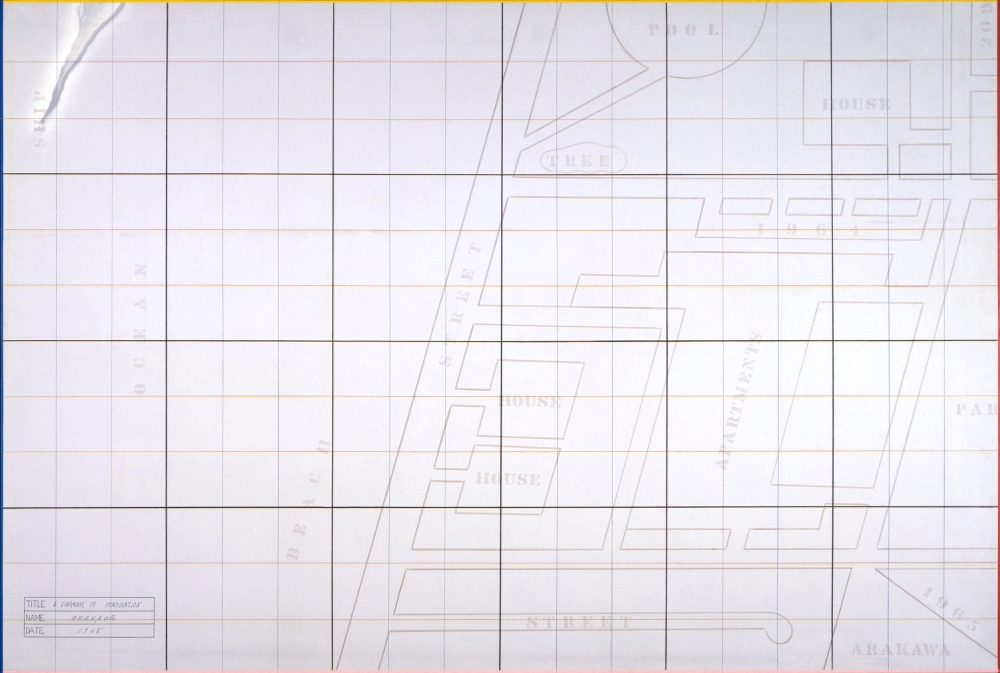
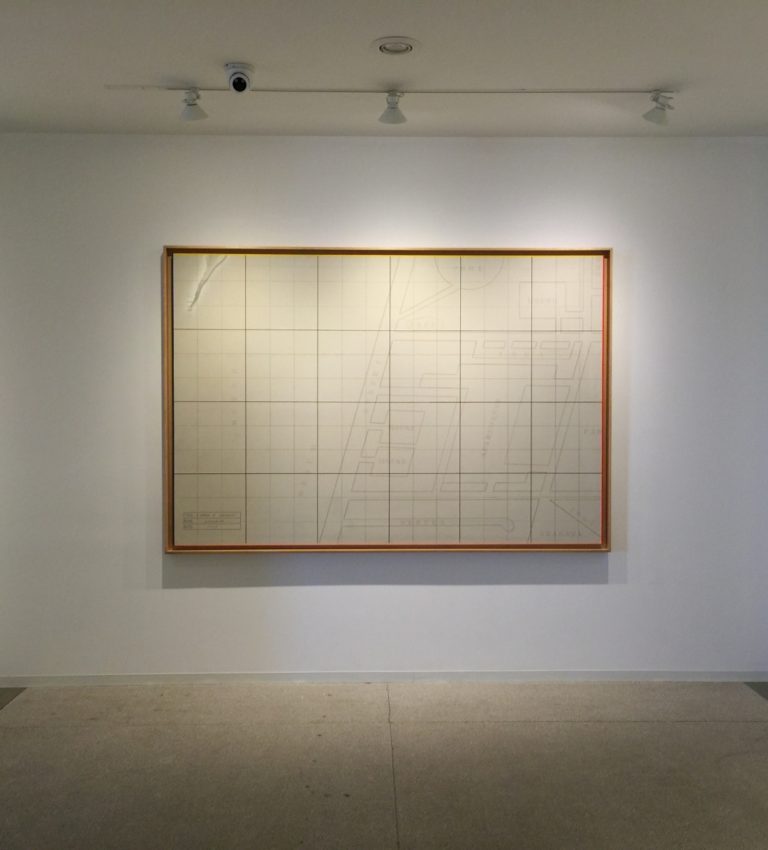
Structure described through a reduction to the essential line is central to Calvino’s thought and this exhibition. Of the work of Arakawa (b. 1936, Nagoya, Japan; d. 2010, New York City, USA), Calvino wrote, ‘…lines belong to bundles of lines which may have a common point of departure or else may converge in a point, in which case they create perspectives.’ Maps, floorplans, and diagrams of three- dimensional structures feature prominently in Arakawa’s painting from the mid-1960s to the mid-1980s. Then, working with poet and philosopher Madeline Gins, he redirected his energies to ‘reversible destiny architecture’, a term coined by them to describe an idealistic, utopian architecture. Arakawa’s drawings in this exhibition are from his transitional period, when he was beginning to think about the potential of architecture.

Giulio Paolini (b. 1940, Genoa, Italy) and Calvino maintained a close relationship. The two were united by a common interest in the space of the mind and its representation. While Calvino approached it from a narrative perspective Paolini questioned it visually. Their exchange was premised on conceptual grounds and it brought to the fore how space could be envisioned and mapped. In this exhibition the notion of mental space will be explored in connection with the idea of imagined city.

Calvino’s ‘spider web’ city swings over an abyss, tied with ropes to two mountain tops, its precarious situation opposing gravity. Parallels can be drawn with Tomás Saraceno’s (b. 1973, San Miguel de Tucumán, Argentina) prototypes for floating cities. His hanging sculptures, including ‘IC 4970/M+W’ (2016) in the exhibition, are part of his long-term research project, Cloud Cities, which aims to develop a ‘modular and transnational city in the clouds’ that represents a model for sustainable and emancipatory building practices.

Flavia Frigeri is an Art Historian and Curator, currently Teaching Fellow in the History of Art department at University College London. Previously she served as a Curator, International Art (2014–16) and Assistant Curator (2011–14) at Tate Modern, where she worked on exhibitions, acquisitions and permanent collection displays. She co-curated (with Jessica Morgan) The World Goes Pop, a reassessment of pop art from a global perspective. Previous projects include Henri Matisse: The Cut-Outs, Paul Klee: Making Visible and Ruins in Reverse. From 2010 to 2011 she was the Solomon R Guggenheim Foundation’s Hilla Rebay International Fellow. She has written widely on: Post-war Italian Art, Pop Art, exhibition histories and contemporary art.


Waddington Custot, 11 Cork Street, London W1S 3LT
Dates: 7 March–4 May 2018
Opening Hours: Monday to Friday, 10am to 6pm Saturday: 10am to 4pm

For more information please visit: www.waddingtoncustot.com

Categories
Programs Recent Exhibitions

Multiple Modernisms

The Chrysler Museum of Art is pleased to announce Multiple Modernisms – an exhibition of modern and contemporary art that features the work by Arakawa, Untitled, 1963 (Gift of Walter P. Chrysler, Jr.). 

This reinstallation of the Chrysler Museum’s McKinnon Galleries highlights pieces in the Museum’s permanent collection through an examination of differing narratives about the history of modern and contemporary art. The exhibition shows similar approaches between artists, many who worked simultaneously or successively. It also explores contradictory ideas influenced by politics and socioeconomics. “Multiple Modernisms takes as its thesis that art history is messy. It is not one art practice progressing into another in a clear, straight manner. Instead, artists had different theories about what modern and contemporary was, what art should present to society and what impacts it could have. The exhibition also emphasizes that certain trends in art practice, such as representing the body or abstraction, were repeated in various manners throughout the 20th and 21st centuries,” said Kimberli Gant, Chrysler Museum’s McKinnon Curator of Modern & Contemporary Art.

Multiple Modernisms pairs internationally renowned artists like Jackson Pollock and Georgia O’Keeffe with those of local or regional acclaim like Norfolk artist Vic Pickett. The exhibition also showcases work by female artists, artists of color and artists from other countries. “I wanted this presentation to show the breadth and depth of the Museum’s collection. It was important to show there are alternate narratives to the history of contemporary art because not all artists or genres were or are embraced within the canon. Art history is fluid and constantly being revised. I want to highlight that,” said Gant.

Multiple Modernisms is guided by six themes including Sculpted Figures, The Gesture, Invoking Geometry, Refined Dynamism, Layered Perspectives and (Hyper) Reality. Sculpted Figures features three-dimensional interpretations of the human body. The Gesture presents works that emphasize the artist’s expressive mark on the canvas. In Invoking Geometry, viewers see images of shapes and patterns. Refined Dynamism focuses on works about movement within a restrained color palette, while Layered Perspectives presents artistic interpretations of major events, symbols, mythology and society.  (Hyper) Reality includes works presenting an extreme version of reality. “In organizing the exhibition by themes, viewers will see how artists were influenced by each other, created similar or conflicting perspectives on the same event and experimented with the same techniques or ideas across time and geography,” said Gant.

The modern and contemporary art exhibition opens November 16 at 6 p.m. with a 1960s-themed reception. The opening reception is free for members, $5 for all others.

For more information please visit: www.chrysler.org

Alexander Calder (American, 1898-1976), Totem, ca. 1970. Painted metal Gift of Walter P. Chrysler, Jr., 71.784 ©Alexander Calder Estate / Artists Rights Society (ARS), New York
Categories
Events Programs

Why Not (A Serenade of Eschatological Ecology)

Join Reversible Destiny Foundation and Dillon + Lee in the film screening of Arakawa’s Why Not (A Serenade of Eschatological Ecology) (1969) at Williamsburg’s National Sawdust.

Renowned for his paintings, drawings, prints, and visionary architectural constructions, Arakawa was one of the earliest practitioners of the international Conceptual Art movement of the 1960’s. His wide range of experimentation extended into
filmmaking. Why Not is a surrealistic exploration, by a young
female protagonist, of both her psychological and physical realms, shot entirely within an enclosed space of an apartment (Arakawa’s studio).

The screening is a rare opportunity to see it in full, in the backdrop of the innovative venue of National Sawdust.  The program is introduced by Miwako Tezuka, Consulting Curator of the Reversible Destiny Foundation and Diana Lee, partner of Dillon + Lee, and followed by a post-screening discussion and Q&A with Peter Katz, the Foundation’s Executive Director and Jay Sanders, Artists Space Executive Director and Chief Curator. 

Monday October 16, 7:00pm

National Sawdust
80 N 6th Street
Brooklyn, NY 11249

For tickets visit: nationalsawdust.org

Film written and directed by Arakawa
Narration: Madeline Gins
Cast: Mary Window
Music: Toshi Ichiyanagi 

110 minutes, 1969

7:00pm | Screening of Why Not (A Serenade of Eschatological Ecology) 
9:00pm | Discussion & Q&A

Program Participants:


Peter Katz has led the Reversible Destiny Foundation
as Executive Director since 2015. He was previously the Chief Operating Officer at MoMA PS1 from 2011 to 2014 and also worked at the Neue Galerie, MoMA, and the Guggenheim in their finance and administration departments. 

 
Diana Seo Hyung Lee is a New York City based writer, translator, and partner of Dillon + Lee. Her writing and translations have appeared in Flash Art, The Brooklyn
Rail, ArtSlant, Degree Critical Blog,ArtAsiaPacific, Seaweed Journal, and The Forgetory, an online publication she helped start, where she currently serves as a contributing editor.

 
Jay Sanders is Director & Chief Curator of Artists Space in New York City. From 2012–2017 he was the Engell Speyer Family Curator and Curator of Performance at the Whitney Museum of American Art. His recent exhibition Calder: Hypermobility is on view at the Whitney through October 23, 2017.
 
Miwako Tezuka is Consulting Curator of the Reversible Destiny Foundation since 2015. Formerly, she was Japan Society Gallery Director (2012–15) and Curator of Contemporary Art at Asia Society in New York (2005–12).
Dr. Tezuka is also Co-Director of PoNJA-GenKon, an international network of scholars and curators in the field of post-1945 Japanese art.

Click here to read article from Whitehot Magazine

Categories
Events Programs

Neon Dance: Puzzle Creature

Reversible Destiny Foundation is pleased to announce the World Premier of “Puzzle Creature” by Neon Dance, to be held on September 15 & 16 at Kamigo Clove Theater as one of the highlights of the Echigo-Tsumari Art Triennale, Japan 2018.
 
Puzzle Creature, a term coined by Arakawa + Gins, refers to an organism’s constant questioning of its existence and surroundings; “Who or what are we as this species? Puzzle creatures to ourselves, we are visitations of inexplicability” – Madeline Gins and Arakawa, Architectural Body.

Through diverse meditations on this broader question, Neon Dance has created a beautiful and engaging work that leads us on an unforgettable journey.

For ticket reservation please visit: www.echigo-tsumari.jp

Dates

Saturday, September 15 2018
Sunday, September 16 2018
Start 18:00〜 pm.  / Open 17:30 pm.

Location
Echigo-Tsumari Kamigo Clove Theatre
7-3 Miyanohara, Kamigo, Tsunan-town, Nakauonumagun, Niigata

Cost
Adult JPY2500 (including tax) / Advance purchase JPY2000
ETAT2018 passport discount JPY2300 / Children age between 7 and 18 JPY1000

Dates

Saturday, September 15 2018

Sunday, September 16 2018

Start 18:00〜 pm.  / Open 17:30 pm.

Location

Echigo-Tsumari Kamigo Clove Theatre

7-3 Miyanohara, Kamigo, Tsunan-town, Nakauonumagun, Niigata

Cost

Adult JPY2500 (including tax) / Advance purchase JPY2000

ETAT2018 passport discount JPY2300 / Children age between 7 and 18 JPY1000


Choreographer: Adrienne Hart

Adrienne initially trained at Swindon Dance, winning a scholarship at the age of 17 to train at London Contemporary Dance School. She now works internationally as a choreographer and as Artistic Director of Neon Dance. Neon Dance is currently resident company at Swindon Dance (2017-19) and Adrienne is part of Sadler’s Wells Summer University programme (2015 – 2018), designed to support mid-career dance artists over a four-year period.

Adrienne has worked in Russia, Belgium, Norway, Germany, Kosovo, USA and Japan. Her work has been commissioned and supported by Arts Council England, British Council, Creative England, The Place, Modern Art Oxford, Glastonbury Festival, Art Front Gallery, DanceXchange and Pavilion Dance South West amongst others. Follow @ADRIENNE__HART

Performers: Luke Crook, Mariko Kida, Carys Staton
Music: Eliane Radigue, Sebastian Reynolds
Scenography: Numen / For Use
Costume / props: Ana Rajcevic
Sign language (English): Jemima Hoadley
Sign language (Japanese): Chisato Minamura

Categories
Programs Recent Exhibitions

ARAKAWA: SIX PAINTINGS

The Reversible Destiny Foundation and Gagosian are pleased to announce the exhibition of six paintings by Arakawa. 

The exhibition will be on view from May 2 through May 26th, 2017 at the Gagosian gallery at 555 West 24th Street, New York. 

Hours: Tue–Sat 10AM-6PM


VISIT WEBSITE

For further information please contact the gallery at newyork@gagosian.com or at +1.212.741.1111.

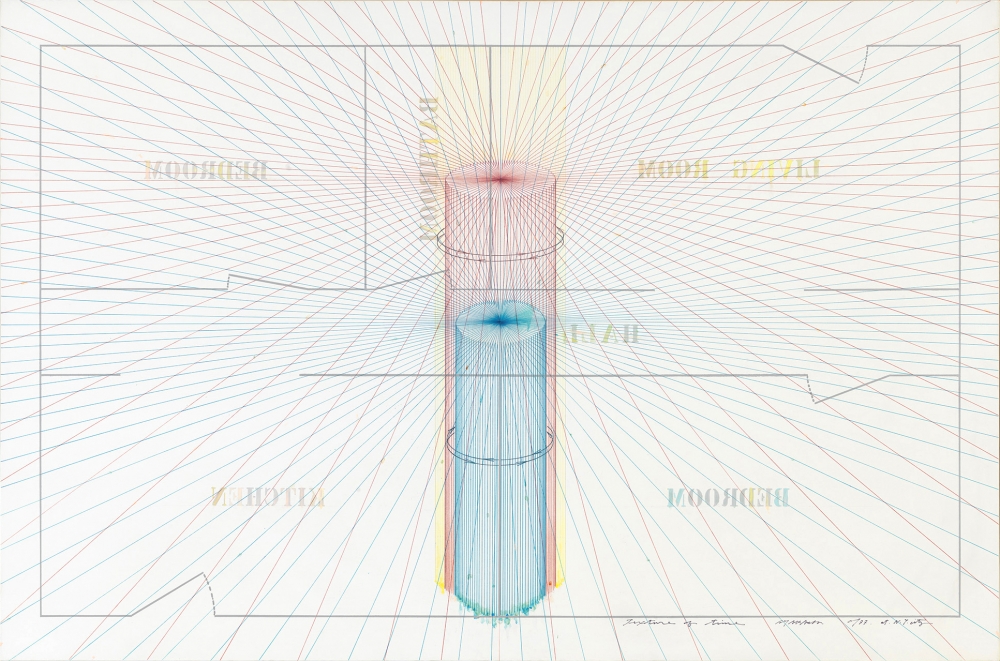
(Image: Arakawa, Texture of Time, 1977; Estate of Madeline Gins)

 
Categories
Events

ARTnews: ARAKAWA HEADS TO GAGOSIAN

The Reversible Destiny Foundation is pleased to announce the partnership with Gagosian Gallery, as featured in ARTnews.

CLICK HERE TO READ ARTICLE

“It has been anthologized in museum collections and exhibitions,” Gagosian Gallery director Ealan Wingate told ARTnews of Arakawa’s work, “but our current time has not kept up with it.”

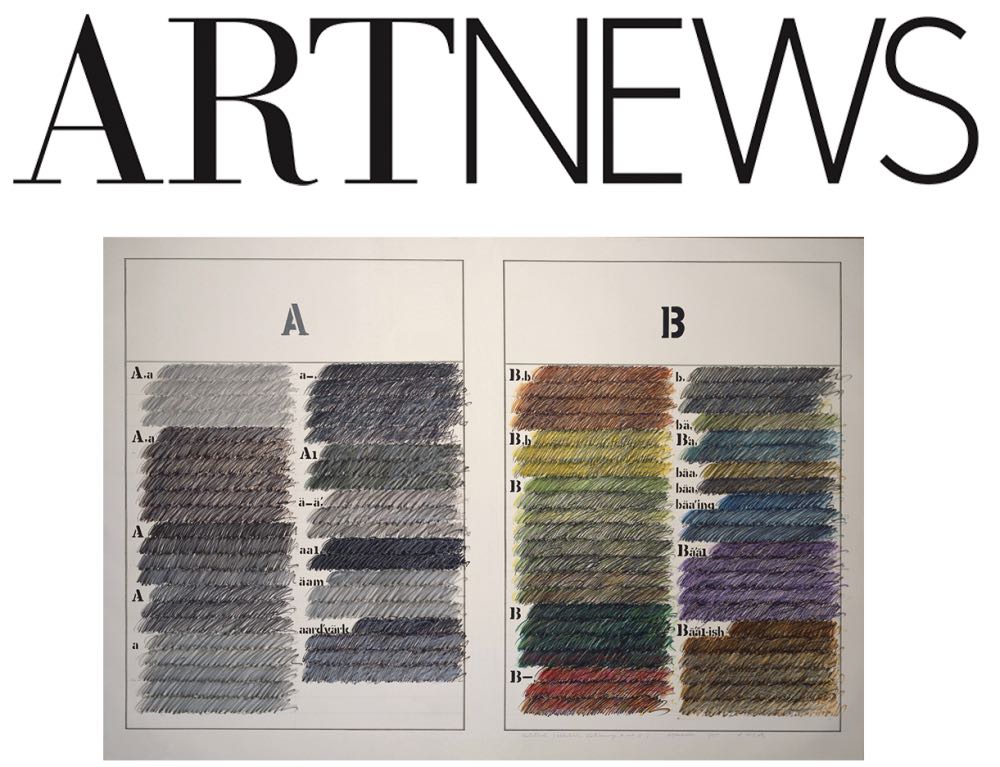
Arakawa’s 2-D artworks will be the primary focus of the Gagosian collaboration. Chief among them is The Mechanism of Meaning (1963-1973), an 80-panel painting series that exists in two different versions, one at the Sezon Museum of Modern Art in Japan and the other in the holdings of the foundation. Reversible Destiny also has desires to bring out past writings and more eclectic work.

“Now we are looking at marvelous generations of artists who feel free to explore different ways of communicating through words, line, color, form, diagrams. It’s interesting to go back to a forerunner.”

ARTnews, February 1, 2017

Categories
Programs Recent Exhibitions

Los Angeles to New York: Dwan Gallery, 1959–1971

The first major exhibition to explore the storied history of the groundbreaking mid-20th-century Dwan Gallery will premiere at the National Gallery of Art, Washington, from September 30, 2016, through January 29, 2017. Honoring Virginia Dwan’s gift from her extraordinary personal collection to the National Gallery of Art, Los Angeles to New York: Dwan Gallery, 1959–1971 will be on view in Concourse galleries of the newly renovated East Building. The exhibition traces Dwan’s remarkable career as a gallerist and patron through some 100 works drawn from her collection as well as from museums and private collections. The exhibition includes Arakawa’s Untitled, “Stolen”, 1969, collection of Wadsworth Atheneum Museum of Art, Hartford.

Los Angeles to New York: Dwan Gallery, 1959–1971 was organized by the National Gallery of Art. The exhibition travels to the Los Angeles County Museum of Art, where it will be on view from March 19 through September 10, 2017.

VISIT WEBSITE

Categories
Events Programs

Children Who Won’t Die

Reversible Destiny Foundation and Triple Canopy are pleased to present a screening of Children Who Won’t Die (2010). Directed by Nobu Yamaoka and scored by composer Keiichiro Shibuya, the documentary is a meditation on the work of Japanese artist Arakawa and his efforts, with his wife and creative partner Madeline Gins, to “reverse destiny” and free humanity from the necessity of death.

Children Who Won’t Die is part of Triple Canopy’s Vanitas issue, which explores contemporary meditations on mortality as well as the delights, delusions, and pressures of fleshly existence. The issue will also include an essay on the anti-death architecture of Arakawa and Gins by Triple Canopy senior editor Matthew Shen Goodman and Lucy Ives. The film is in Japanese with English subtitles, and will be introduced by Shen Goodman.

VISIT WEBSITE


November 3, 2016

7:00 p.m.

264 Canal Street, 3W, New York, New York

Free admission

Categories
Events Programs

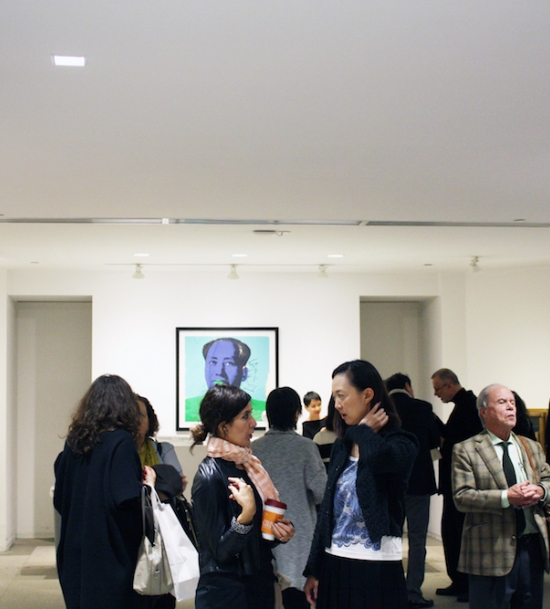
Points of Convergence: Arakawa and the Art of 1960’s – 1970’s

Born in Nagoya, Japan, Arakawa rebelled as a Neo Dada artist in the late-1950’s Japanese art world. Fiercely independent and inspired by Marcel Duchamp’s “art in the service of the mind,” he moved to New York in 1961. This growing city of avant-garde experimentation attracted artists from all over the world; including many Japanese artists such as: Ay-O, On Kawara, Naoto Nakagawa, and Yoko Ono; whose paths crossed in life as well as participants in heated discussions about the nature and meaning of art. Living in the midst of this fast-changing scene of the 1960s and 70s, Arakawa along with these artists became an integral part of the emergence of Minimalism and Conceptual Art.

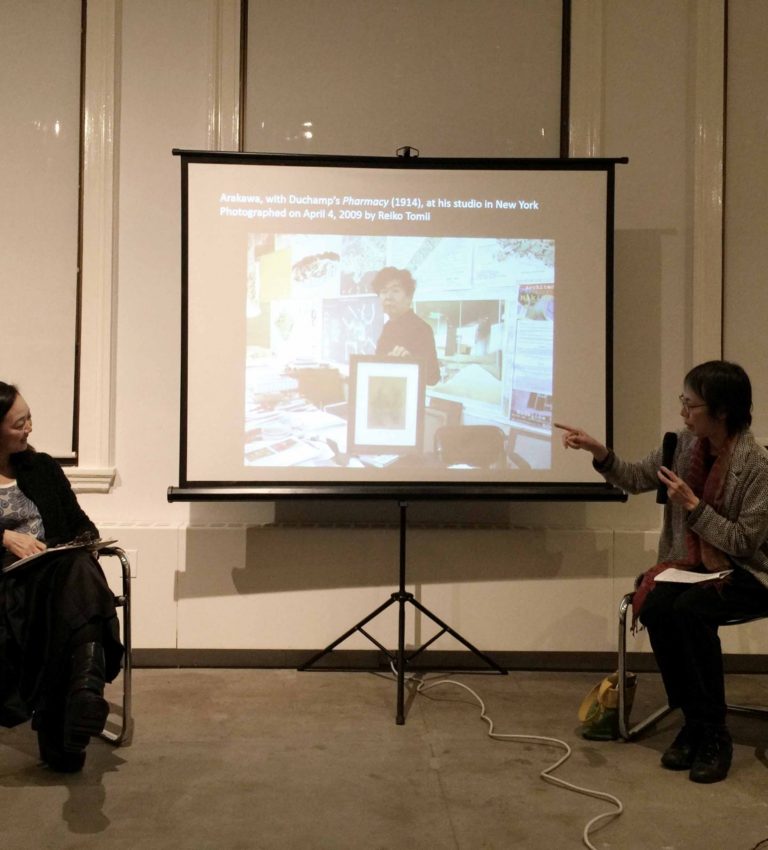
The panel discussion Points of Convergence invited distinguished speakers who brought to the table distinct perspectives into the art and philosophy of Arakawa and how they may be contextualized within the international art of the time. Dr. Charles Haxthausen has authored key texts for deciphering often-cryptic art of the artist by applying not only art-historical but also philosophical analyses. The painter Naoto Nakagawa became acquainted with Arakawa in 1965, recalled times spent in the fellowship of like-minded artists from Japan and beyond. Dr. Reiko Tomii, with her in-depth knowledge of postwar Japanese art history, keenly detects what changed and what remained constant in the art of Arakawa during the two decades that thrust him into the world.

In collaboration with Asia Contemporary Art Week and hosted by Artnet, this event launches Reversible Destiny Foundation’s series of public programs.

Points of Convergence: Arakawa and the Art of 1960s – 1970s

Panelists:

Charles “Mark” Haxthausen is Robert Sterling Clark Professor of Emeritus of Art History at Williams College, where he taught from 1993 to 2016. During that time he served for fourteen years as director of the Williams College/Clark Art Institute Graduate Program in the History of Art. Professor Haxthausen has played a significant international role as a curator and consultant in the field of modern and contemporary German art. Known for his work on Paul Klee, he has published numerous articles on German artists and critics. He edited the book The Two Art Histories: The Museum and the University and co-edited Berlin: Culture and Metropolis. His exhibition, Sol LeWitt: The Well-Tempered Grid, presented at the Williams College Museum of Art in 2012, won the Association of Art Museum Curators’ award of excellence for the Outstanding Exhibition in a University Museum in North America. His book, Carl Einstein: Refiguring Visuality, is forthcoming from the University of Chicago Press.

Naoto Nakagawa was born in Kobe, Japan in 1944 and in 1962 he immigrated to New York City. His paintings have been widely exhibited, starting in 1968 at the legendary avant-garde Judson Gallery and recently at Feature, Inc. in New York. A two-part survey of Nakagawa’s work was mounted with his early work at White Box and his current work at Ethan Cohen Fine Arts. His work is included in many public and private collections including the New York Museum of Modern Art. He has taught at Columbia University and Parsons School of Design.


Dr. Reiko Tomii is an independent art historian, who investigates post-1945 Japanese art in global and local contexts. Her research topic encompasses “international contemporaneity,” collectivism, and conceptualism in 1960s art, as demonstrated by her contribution to Global Conceptualism (Queens Museum of Art, 1999), Century City (Tate Modern, 2001), and Art, Anti-Art, Non-Art (Getty Research Institute, 2007). Her book, Radicalism in the Wilderness: International Contemporaneity and 1960s Art in Japan, was published from MIT Press in Spring 2016.

The program was moderated by Dr. Miwako Tezuka, Consulting Curator of Reversible Destiny Foundation.
Download PDF of article from Artnet
Categories
Events Programs

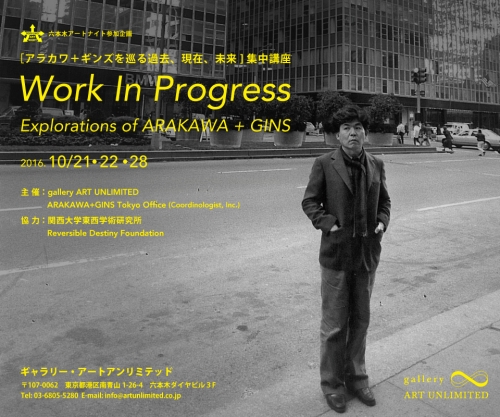
Work in Progress – Explorations of Arakawa + Gins

Lecture series at gallery Art Unlimited
October 21, 22, 28, 2016

Organized by gallery ART UNLIMITED, ARAKAWA + GINS Tokyo Office (Coordinologist, Inc.)

In Cooperation with The Institute of Oriental and Occidental Studies – KANSAI UNIVERSITY / Reversible Destiny Foundation

Categories
Programs Recent Exhibitions

The Eye of Arturo Schwarz

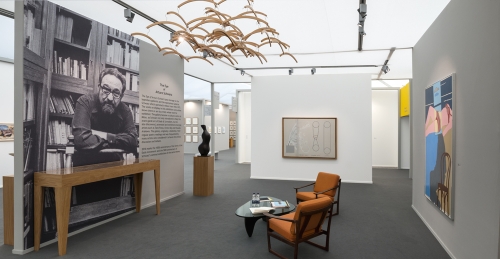
At Frieze Masters, 2016, Eykyn Maclean presented The Eye of Arturo Schwarz, an homage to the legendary gallerist and the eponymous Galleria Schwarz, which operated in Milan from 1954-1975.  The gallery became a cultural center in Milan, as Schwarz not only introduced Italy to the avant-garde art of Dada and Surrealism, but also discovered, promoted, and exhibited emerging artists such as Tano Festa, Enrico Baj, and Shusaku Arakawa.  The gallery, originally a bookshop, held regular poetry readings and was frequented by artists who considered it a haven for artistic discussion and debate.  Galleria Schwarz was one of the most prominent galleries in Europe after the war, and left a void beyond the Italian art market when it closed in 1975. 

To help recreate the atmosphere of Galleria Schwarz, all works in this exhibition were either shown at the gallery or are by artists whose work Schwarz exhibited. Works included paintings, sculpture, original catalogues from past Schwarz exhibitions, as well as books of poetry published by Schwarz.  

2016 marks the 100th anniversary of the birth of the Dada movement and the 50th anniversary of Schwarz’s seminal exhibition of the same theme.

VISIT WEBSITE